

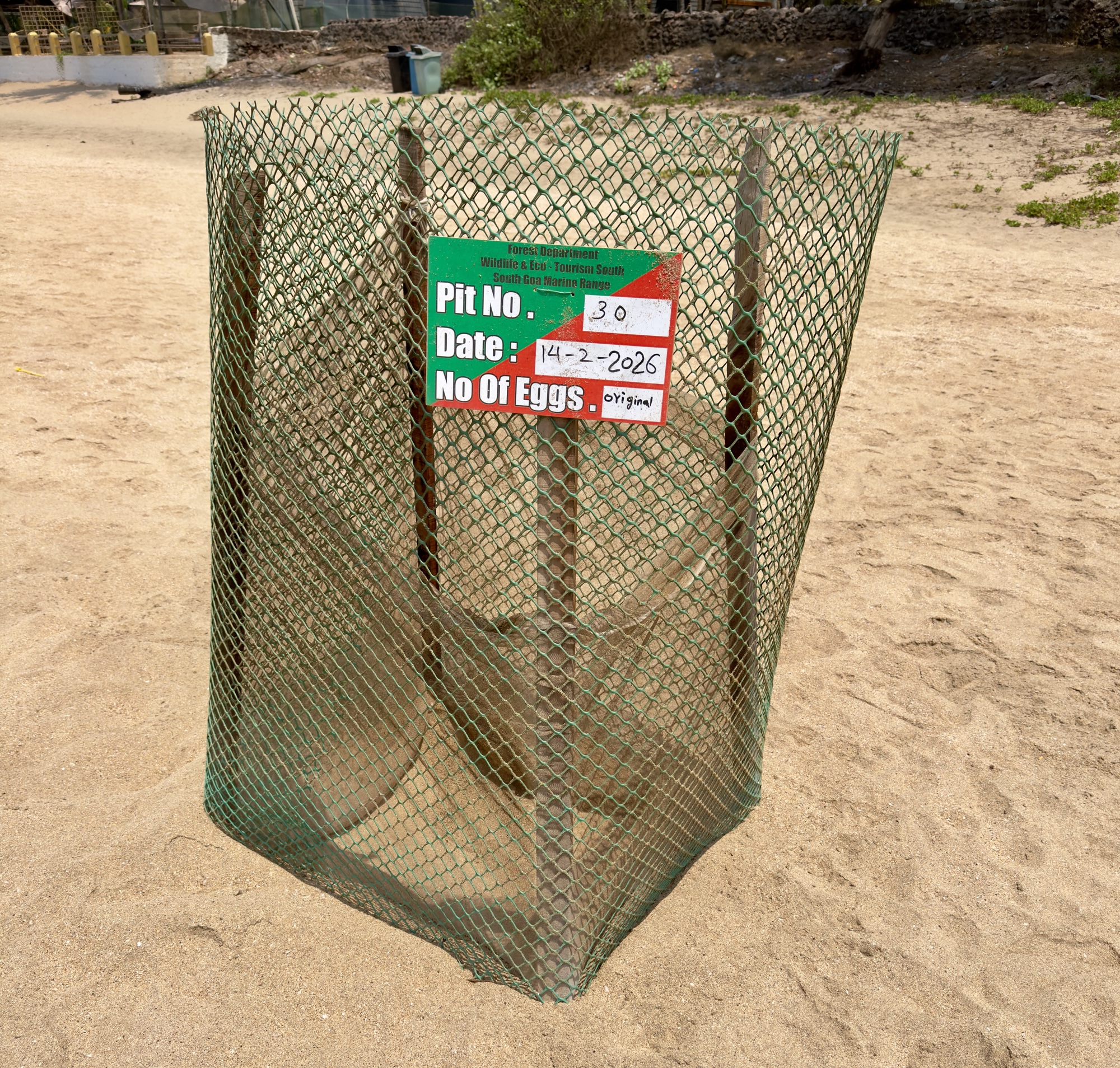

I was walking along Palolem Beach one morning when I noticed something that didn’t quite fit the usual furniture of the beach. A small green mesh enclosure, staked into the sand with wooden posts. An official-looking label on the front.
Pit No. 30. Date: 14 February 2026. Forest Department, Wildlife and Eco-Tourism, South Goa Marine Range.
A sea turtle had come ashore during the night and laid her eggs just above the tideline.
The Forest Department had got there first, or shortly after. The mesh cage is standard practice along this stretch of coast: it marks the nest, keeps dogs and careless feet away, and lets the sand breathe while making the site visible to anyone who walks past. There was no guard. Just the cage, the label, and the assumption that people would understand what they were looking at.
The eggs stay buried for 45 to 60 days. Pit 30 was laid on 14 February, which meant that by the time I was standing there in late March, the hatchlings were either already gone or within days of emerging. I had no way of knowing which side of it I was on. The sand looked undisturbed, which could mean anything.
They emerge at night and head toward the brightest point on the horizon. For most of their existence this meant the moon on the water. On developed coastlines it can mean the lights from a beach shack, which is one of the less romantic ways a species can be steered off course. The fraction that make it to adulthood is small enough that every nest counts.
Palolem is a busy beach. Tourists, fishermen, beach shacks, boat trips. The turtles were here long before any of it, returning each season to the same stretch of sand where they were born. The Forest Department has been counting the nests long enough to give them numbers. Thirty, this season, on this beach alone.
I stood there for a while. Just the cage, the label, the number. It stayed with me longer than most of the things I did photograph that day.
India and Sri Lanka 2026 — all posts
- Day 1 — 24 Hours to Mumbai
- Day 2 — First Morning in Mumbai
- Day 3 — Exploring Mumbai
- Dhobi Ghat: Mumbai’s Laundromat
- Day 4 — Sightseeing in Colombo: One Day is Enough
- A Short History of Ceylon
- Day 5 — Kandy: Moving into the Mountains
- Day 6 — Moving on to Ella
- Day 7 — Hike and Sunstroke
- Tea in Sri Lanka: From a Blight in 1869 to Four Million Cups a Day
- Day 8 — Nine Arches Bridge
- Day 9 — Tuktuk Tour Around Ella
- Day 10 — Time to Leave Ella
- Orphans of Udawalawe: Inside Sri Lanka’s Elephant Transit Home
- Day 11 — Safari and Galle Fort
- Day 12 — Onwards to Negombo for the last day in Sri Lanka
- Day 13 — All the problems concentrated on a single day
- Royal Enfield: Why India Rides Different
- Day 14 — The Kerala Backwaters
- Day 15 — Local bus to Munnar
- Leyland, a familiar name from the past
- Buying a beer in Kerala: Local knowledge required
- Mahindra: The Jeep That Never Left
- Discovering India Through Its Food – One Plate at a Time
- Day 16-19 — Four Relaxing Days in Munnar
- Day 20 — Travel to Kumily
- Day 21 — I Was Ready, Tigers Were Not
- Kathakali and Kalaripayattu
- Day 22 — Kumily to Varkala: The Journey is the Reward
- Day 23 — Slow day in Varkala
- IndiGo: Air travel for the masses
- Day 24 — Breakfast in Varkala, lunch in Bangalore, dinner in Goa
- Pit No. 30