


The cheapest way from Hong Kong to Taipei that week was not a budget airline. It was STARLUX, which sells itself as a luxury carrier and, on this route at least, prices like the opposite. I paid SEK 1,412 (about US$150) for the two-hour flight, and that included a checked bag, a seat with its own screen and a hot lunch of chicken, rice and vegetables. On a low-cost carrier the bag alone would have been the first argument.
The only thing that did not run to plan was the start. Everyone was on board on time, and then we sat at the gate for forty-five minutes before pushing back. It was the second day of Golden Week, and half of Hong Kong seemed to be leaving with me. Once we were in the air it was smooth. I watched a movie, ate my lunch, and two hours later we were in Taiwan.
Taipei’s airport is forty kilometers out of town, and the express train covers it in under forty minutes. One change to the Blue Line and I was in Da’an, looking for a guesthouse down a side lane. Nobody was there. I sent a message to the host on WeChat, and a moment later the door unlocked itself. It was the smoothest check-in of the trip, and I did not meet a single person.
That evening I set out for a night market, got halfway and turned back in a downpour. I found chicken and fries on the way home. Not every first evening has to be a story.
Dihua Street, where the tea went out
Dihua Street is one of the oldest streets in Taipei, and it still does more or less what it was built for. It is a wholesale street: sacks of dried mushrooms and shrimp, herbs and roots in open drawers, fabric by the bolt in the old market hall. On a Saturday it was packed, and I spent two hours walking it under the arcades, photographing shopfronts and people at work.
Finding lunch was harder than it should have been. Most of what was on offer was soup, and I was not in the mood for soup at 29 degrees. In the end I settled for sushi and a cappuccino.
What the shopfronts do not tell you is what this street used to sell to the world. Dadaocheng, the district around Dihua Street, began in the 1850s as a riverside landing on the Tamsui River. When the port at Tamsui opened to foreign trade in 1860, foreign merchants followed, and one of them, a British trader named John Dodd, saw that the hills around the Taipei basin could grow tea. He brought in plants from Anxi in Fujian in 1866, and in 1869 he shipped about 120,000 catties, some 70 tons, from Tamsui straight to New York, in boxes labeled Formosa Oolong.
It sold. Within a few decades Dadaocheng had more than 250 tea houses and trading firms, many of them on this street and the ones beside it. The leaves came down from the hills, were sorted, roasted and packed here, and went out by the river. Wang’s Tea, founded in 1890, still roasts nearby, and in its busiest years it shipped 500,000 catties, about 300 tons, of a single tea in a single year.
The tea trade moved on and the dried mushrooms stayed. I had spent two hours on a street that once packed tea for New York, and I had been looking at the mushrooms. Where the tea actually grew, I found out the next day, from a gondola.
Taipei 101 at sunset
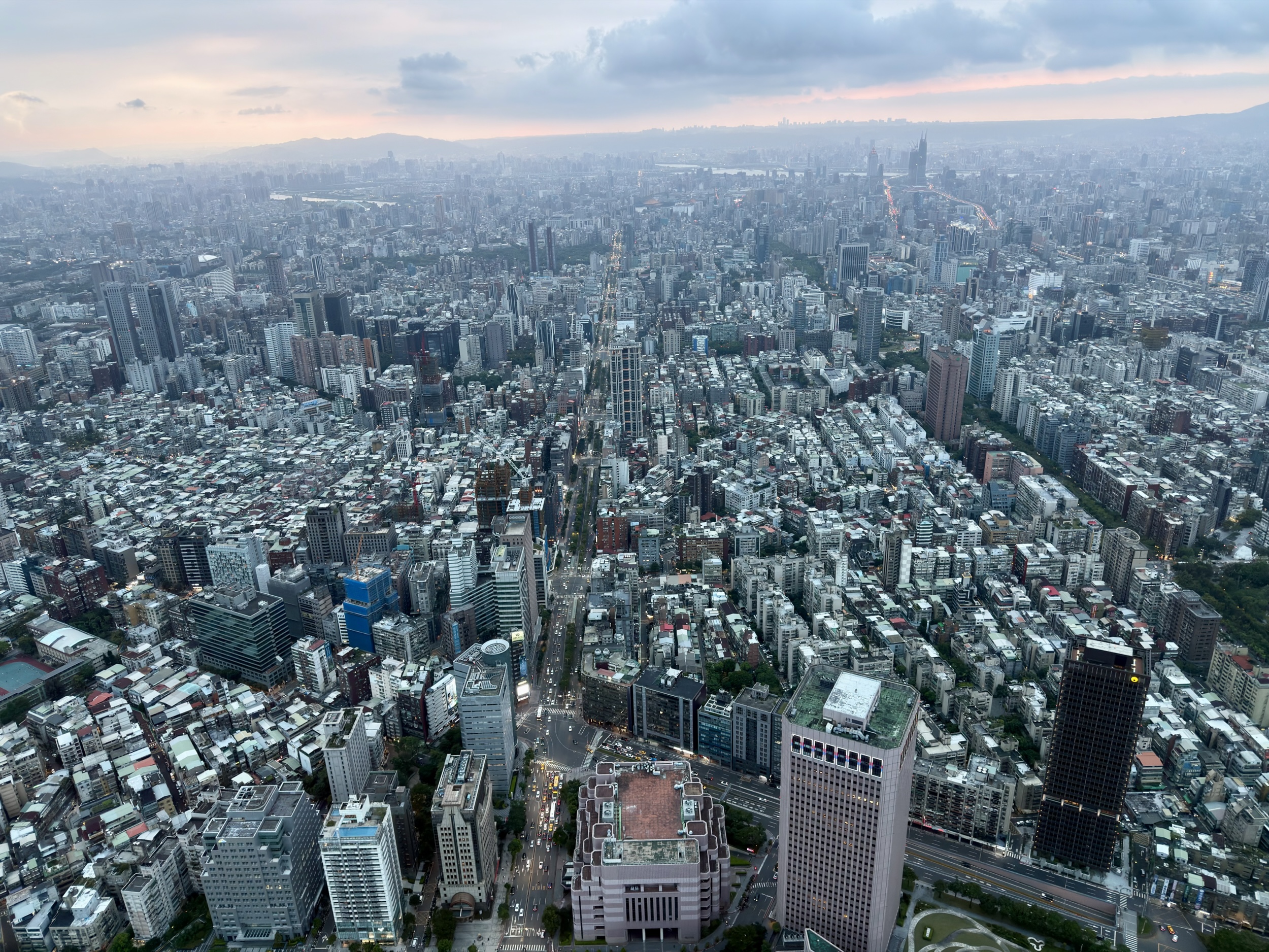
I had a ticket for the observatory at 16:30, which in early October puts you on the 89th floor an hour before sunset. Taipei 101 is 508 meters tall and was the tallest building in the world from 2004 until Dubai overtook it in 2010. The elevator does the climb to 382 meters in about forty seconds, which is about as long as I want to spend thinking about it.
The week before, I had watched the sun go down from the Ping An tower in Shenzhen. This one was hazier. The sunset was more of a dimming than a show, and I stayed for a couple of hours anyway, until the city below had switched itself on.
Dinner was in the mall at the foot of the tower, along with what felt like most of Taipei. Getting home took longer than it should have. Twice I hurried onto a train because it was standing at the platform, and twice it was going the wrong way. The Taipei Metro is easy to use. I am the variable.
Four kilometers of gondola
On Sunday afternoon I took the Brown Line to the end, at the zoo, and got into a gondola cabin. I expected a short hop up a hill. The Maokong Gondola is just over four kilometers long, with four stations, and it takes twenty to thirty minutes to get from the zoo to the top. It climbs from about 24 meters to about 300, and it does not go straight up. Twice it turns a corner and heads off over another ridge, and each time I thought we were nearly there.
What I had not expected was how quickly the city goes. A few minutes out of the zoo there is nothing below the cabin but forest, steep green valleys and ridges folding into each other, and Taipei is somewhere behind you.
At the top, a road runs along the ridge lined with restaurants and tea houses, most of them built to face the view. I picked one looking north over the whole of Taipei and had a waffle with ice cream. It was wonderful, and I am not going to apologize for eating a waffle in tea country.
Because this is where the tea grew, and still grows. The slopes around Maokong are known for Tieguanyin, a roasted oolong a local tea master brought over from Anxi, the same corner of Fujian that John Dodd took his plants from. The name Maokong means roughly “cat hollow,” after potholes worn into the rocks of the streambed that early settlers thought looked like the prints of cats’ paws.
Three things
Two days in Taipei, and I did three things. A street that once packed tea for New York. A tower for the sunset. A gondola that went on far longer than I expected, over hills I had not expected at all.
Taipei, the practical stuff
- How do you get from Hong Kong to Taipei? — By air, about two hours to Taoyuan. My STARLUX fare was SEK 1,412 (about US$150), with a checked bag and a hot meal. Expect a crowded airport in Golden Week, the first week of October.
- How do you get from Taoyuan airport to Taipei? — Airport MRT, the purple express train, 35 to 40 minutes to Taipei Main Station for NT$160 (about US$5). Buy an EasyCard at the airport; it works on the metro, buses, the Maokong Gondola and in convenience stores.
- What does a guesthouse in Taipei cost? — Mine in Da’an, near Zhongxiao Dunhua station, cost NT$4,963 (about US$153) for three nights. Basic but spacious and run like an Airbnb: electronic locks, check-in by message, no reception and no luggage storage.
- How do you get to Dihua Street in Taipei? — Green Line to Beimen, then a six-minute walk. Covered arcades most of the way help in rain. Weekends are crowded, and it sells more dried goods than food, so eat before or after.
- How much is the Taipei 101 observatory? — NT$600 (about US$19) for the 89th-floor observatory. Book a timed slot online for about an hour before sunset.
- How long is the Maokong Gondola? — Four kilometers, 20 to 30 minutes one way, NT$180 (about US$6) to the top with the EasyCard. Take the Brown Line to Taipei Zoo, the last stop, and walk five minutes. It is closed most Mondays, and on weekend afternoons the line to come back down gets long.
- What is the weather like in Taipei in early October? — 25 to 32°C, humid, with a heavy shower on the first evening of my stay. Carry an umbrella and something to drink.
China 2026 — all posts
- 1 — Shanghaied
- 2 — Three days in Shanghai
- 3 — Xi’an, the beginning of the Silk Road
- 4 — Chengdu, panda town
- 5 — Chongqing, the world’s biggest city?
- 6 — Zhenyuan, the other Silk Road
- 7 — Xijiang, the village that is paid to look like itself
- 8 — Zhangjiajie, the mountain that was renamed after a film
- 9 — Yangshuo, the view on the twenty
- 10 — Shenzhen, from thirty thousand people
- 11 — Why China’s big cities are so quiet
- 12 — Hong Kong, nowhere to go but up
- 13 — Traveling through China’s holidays
- 14 — Taipei, four kilometers of gondola
- 15 — Alishan, the forest that left by train
- 16 — Tainan, where the gods answer yes or no
- 17 — Taiwan, a short history of a long question
- 18 — Why Uber in Taiwan sends you a taxi
- 19 — Hualien, a gorge you can only look at
- 20 — Jiufen, the gold you are allowed to touch
- 21 — Beware of Old Street
- 22 — Taipei, the crates that crossed the strait
- 23 — Shanghai again, through new glasses
- 24 — Train travel in China
- 25 — Paying for things in China, Hong Kong and Taiwan
- 26 — Getting online behind the Great Firewall
- 27 — China at 72
- 28 — Six weeks in China and Taiwan: the route, and what I would change
Before you go: Planning a trip to China · Essential apps for travelling in China