


The bus from Chiayi takes two and a half hours to climb 2,000 meters, and it does it the way mountain buses do everywhere: hairpin after hairpin, the driver relaxed, the passengers less so. I had started in Taipei at six with a taxi, because the first subway would have made the 06:51 high-speed train too close for comfort. By midday I was standing at 2,200 meters in a cold drizzle, inside the Alishan National Forest Recreation Area, looking for my hotel.
A room with a view of the corridor
I had chosen the hotel for one reason. It is inside the gate, a short walk from the station where the sunrise train leaves before five in the morning. Staying outside means joining the day visitors in the dark. That reason turned out to be the only one. The room was tiny, its one window looked onto a corridor, and the front desk treated questions as an imposition. It was also the most expensive room of the whole trip, TWD 5,800 (about US$180) for two nights, paid in advance. There are very few beds inside the park, and everybody knows it, including the hotel.
The afternoon did not help. Fog came up the valley and stayed, and the drizzle never quite became rain or quite stopped. I bought a ticket for the morning sunrise train at Alishan Station and went back to look at my corridor.
Twenty-five minutes of railway
The sunrise train is a short branch line from Alishan Station up to Zhushan, at 2,451 meters, where a viewing platform faces east toward the Yushan range. It leaves in the dark, full, and climbs for about twenty-five minutes. The forecast had promised a gap in the weather, and for once a forecast kept its word.
The platform was crowded, but there was room at the railing for anyone willing to wait for it. Mist lay in the valleys below, and the sun came up into a completely clear sky. Then, almost as soon as it had cleared the ridge, most of the crowd turned around and went for the train back. They missed the best of it. The light kept changing on the mist for a long while after, and the platform was suddenly a good deal emptier.
It was only on that train that I understood what I had skipped. The little red carriages run on a line that goes all the way down to Chiayi, 86 kilometers and 2,186 meters below, and I had come up by bus.
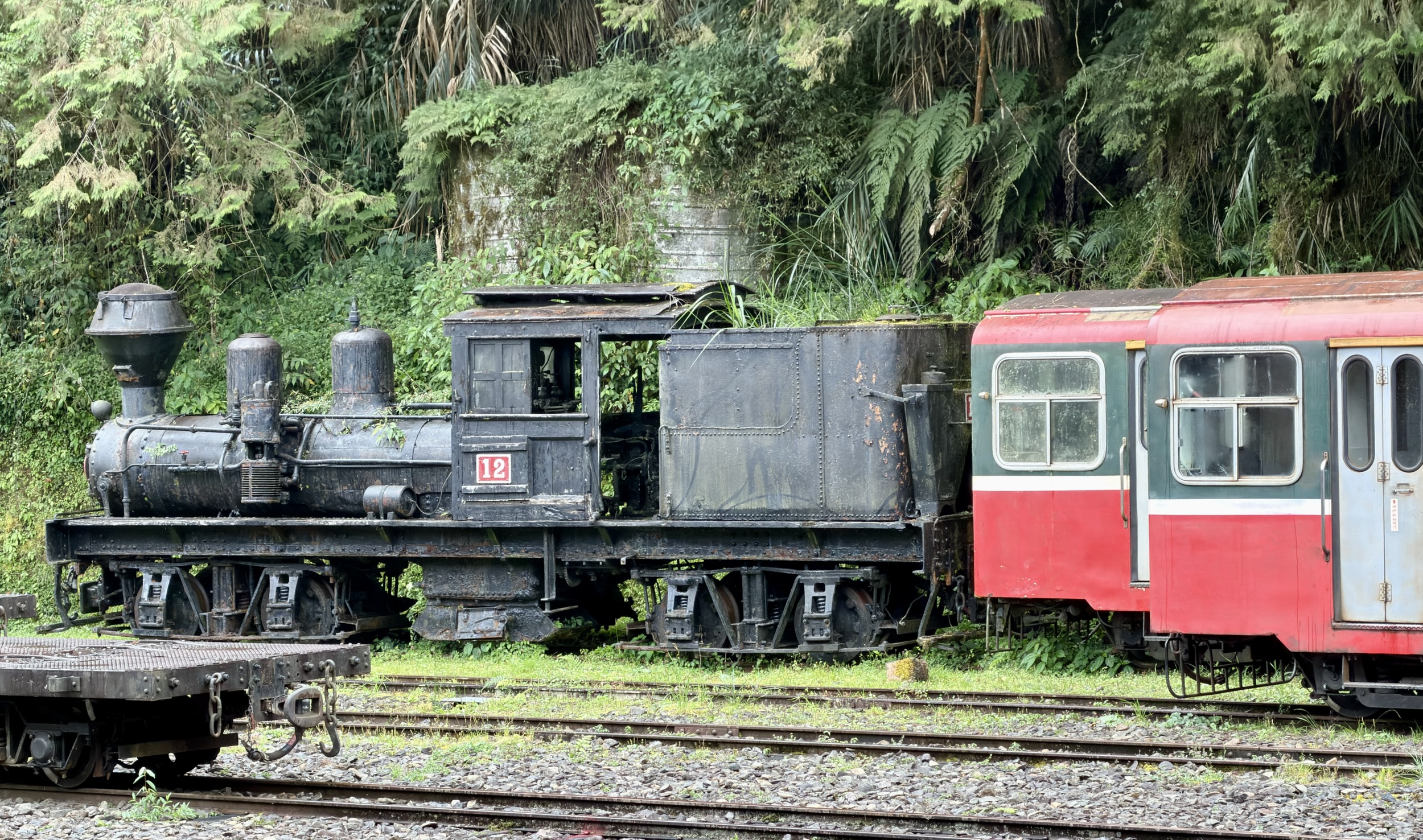
The Alishan Forest Railway was not built for people like me. The Japanese colonial government started work in 1906 and reached the high forest in 1912, and its purpose was to bring the forest down. Taiwan red cypress and Taiwania, trees that had stood here for one, two and three thousand years, went down the mountain on flat cars at a rate of tens of thousands of cubic meters a year. Getting a narrow-gauge railway up 2,000 meters took more than fifty tunnels, seventy-seven wooden bridges, a full spiral around one mountain and a set of switchbacks where the train simply reverses up the slope. The locomotives were geared American Shays, built for logging lines, slow and very strong.
In 1934 the colonial administration held a festival for the spirits of the felled trees and built a monument to them, the Tree Spirit Pagoda, for roughly 100,000 trees and the 77 workers who died cutting and moving them. Logging went on after the Japanese left, under the new government, until there was not much left worth cutting. By the late 1960s it was over.
The railway outlived its purpose. It turned into a tourist line, then a typhoon took it apart: Morakot in 2009 washed out long sections, and the full line was only reopened in July 2024, fifteen years later. The train that was built to empty the mountain now carries people up to look at what is left of it.
Walking down through what was left
I did not take the train back down from Zhushan. A footpath leaves the road just below the platform, 890 meters of steps through the forest, and drops you at Zhaoping. From there a trail runs past the Sister Ponds, two small lakes with a wooden pavilion in the larger one, still and empty at seven in the morning. Then Shouzhen Temple, and then the Giant Tree Trail, a boardwalk through the trees the loggers left. Some of them are numbered. Number 28 is about 43 meters tall and around 2,000 years old.
At one end of the trail stands the Tree Spirit Pagoda, a stone column on a base of round, stepped rings, like the growth rings of a stump. It is a monument erected by the people who cut the forest, to the forest they cut. I am not sure what to make of that, but I stood in front of it longer than I expected to.
The boardwalk was wet and the moss was slippery, and I took it slowly. The trees did not mind. They have outlasted an empire, a logging industry, a lightning strike next door and a typhoon, and a careful seventy-two-year-old on a boardwalk is not much of a test.
By ten the sun was gone. By noon the fog was back, exactly where it had been the day before, and the rest of the day belonged to it.
Two days, two hours
So that was Alishan. Two days, of which I got about five good hours, all of them before ten in the morning. A small room, a large bill, and a forest I could only see when the weather allowed it. If I did it again, I would take the forest railway up from Chiayi. One night is enough if the weather cooperates, but up here that is far from certain, and a second night is the insurance you pay for.
I would still get up at four for the sunrise train. I would still walk down.
The railway came to take the trees away. Most of them went. Some stayed. The ones that stayed are the reason to come.
Alishan, the practical stuff
- How do you get to Alishan by public transport? — High-speed rail from Taipei to Chiayi, about 1.5 hours (my early-bird fare was NT$1,080, about US$33), then the Taiwan Tourist Shuttle bus 7329 from Chiayi HSR station, about 2.5 hours. Over-65s pay half, NT$142 (about US$4.50), with a passport. Book the bus online at cyhg-shop.fontour.com.
- How does the Alishan Forest Railway work? — Uphill trains leave the regular Chiayi station, not the high-speed one, at 09:00 and 10:00 (the 10:00 arrives at 14:56). Downhill, the 11:50 from Alishan reaches Chiayi at 15:45. About NT$600 (about US$19) one way. Book early, because the trains sell out.
- How do you catch the Alishan sunrise train? — The Zhushan line leaves from Alishan Station and takes about 25 minutes. Tickets, around NT$150 (about US$5), are sold at the station the afternoon before, when the next morning’s departure time is posted. In early October it left before five.
- Can you walk down from Zhushan after the sunrise? — Yes. The Zhushan footpath goes down to Zhaoping (890 m of steps), then past the Sister Ponds, Shouzhen Temple and the Giant Tree Trail. About two hours at an easy pace, mostly downhill, and slippery when wet, which is usually.
- Where should you stay in Alishan? — Inside the recreation area if you want to walk to the sunrise train. Rooms are few and prices high, so book early and read recent reviews.
- What is the weather like in Alishan? — Cold before dawn on the platform, 5 to 10°C. In early October the mornings were the only clear hours, and the fog arrived by midday.
China 2026 — all posts
- 1 — Shanghaied
- 2 — Three days in Shanghai
- 3 — Xi’an, the beginning of the Silk Road
- 4 — Chengdu, panda town
- 5 — Chongqing, the world’s biggest city?
- 6 — Zhenyuan, the other Silk Road
- 7 — Xijiang, the village that is paid to look like itself
- 8 — Zhangjiajie, the mountain that was renamed after a film
- 9 — Yangshuo, the view on the twenty
- 10 — Shenzhen, from thirty thousand people
- 11 — Why China’s big cities are so quiet
- 12 — Hong Kong, nowhere to go but up
- 13 — Traveling through China’s holidays
- 14 — Taipei, four kilometers of gondola
- 15 — Alishan, the forest that left by train
- 16 — Tainan, where the gods answer yes or no
- 17 — Taiwan, a short history of a long question
- 18 — Why Uber in Taiwan sends you a taxi
- 19 — Hualien, a gorge you can only look at
- 20 — Jiufen, the gold you are allowed to touch
- 21 — Beware of Old Street
- 22 — Taipei, the crates that crossed the strait
- 23 — Shanghai again, through new glasses
- 24 — Train travel in China
- 25 — Paying for things in China, Hong Kong and Taiwan
- 26 — Getting online behind the Great Firewall
- 27 — China at 72
- 28 — Six weeks in China and Taiwan: the route, and what I would change
Before you go: Planning a trip to China · Essential apps for travelling in China