


The train from Yangshuo to Shenzhen was sold out in second class, so I went first class. The difference turned out to be modest. Two seats on each side of the aisle instead of three and two, a bottle of water, and a box of snacks. Otherwise the same train, the same smooth ride, the same punctual arrival at Shenzhen North.
The hard part came after. I took the metro to the station named after the convention center, which was where my hotel was supposed to be. The station opens into a mall, and getting out of that mall and onto a street where my phone could find GPS took me about half an hour. Then it emerged that I should have gotten off one station earlier. The hotel had sent me a message about it. It reached me after I had checked in. That turns out to be the norm: they send you the welcome message, with the directions, after you have checked in.
An hour and a half from the train to the room. The room was supposed to have no windows, but they upgraded me, and I got a window, air conditioning and everything.
Huaqiangbei
The electronics markets of Huaqiangbei open at ten, so it was a leisurely morning and then the metro.
Huaqiangbei is a district of markets, building after building of small counters stacked floor upon floor, selling phones, parts, cables, chargers and gadgets. I started in the building next to the one I was aiming for, which turned out to be full of consumer electronics on several floors as well, and then went over to the SEG building and wandered for about three hours.
I did not have a list, since I didn’t really need anything. I still came out with:
- a razor
- an AI translator
- a pair of AI glasses
- a fingerprint padlock
- a small USB speaker
- a couple of watch bands
I had a wallet full of cash that I had been advised to withdraw and had barely needed, so I used it, since this was my last day in China. That is my excuse for the frivolous shopping.
Lunch was roast duck at a local street restaurant, which was harder work than it sounds. It came on the bone, and separating duck from bone with chopsticks is a skill I do not have.
Thirty thousand
In 1980 Shenzhen had about thirty thousand people. It was a market town and a scattering of fishing villages on the border with Hong Kong. In May of that year it was designated China’s first Special Economic Zone, the place where the country would try out foreign investment and market prices before letting them loose anywhere else.
It worked faster than anyone planned for. Factories came first, assembling things for companies in Hong Kong across the river, then the companies that made the parts, then the companies that designed the products. Huaqiangbei grew up as the place where all of that was bought and sold. By the 2020 census Shenzhen had 17.5 million people.
That is a city appearing in a single working lifetime, more or less from nothing.
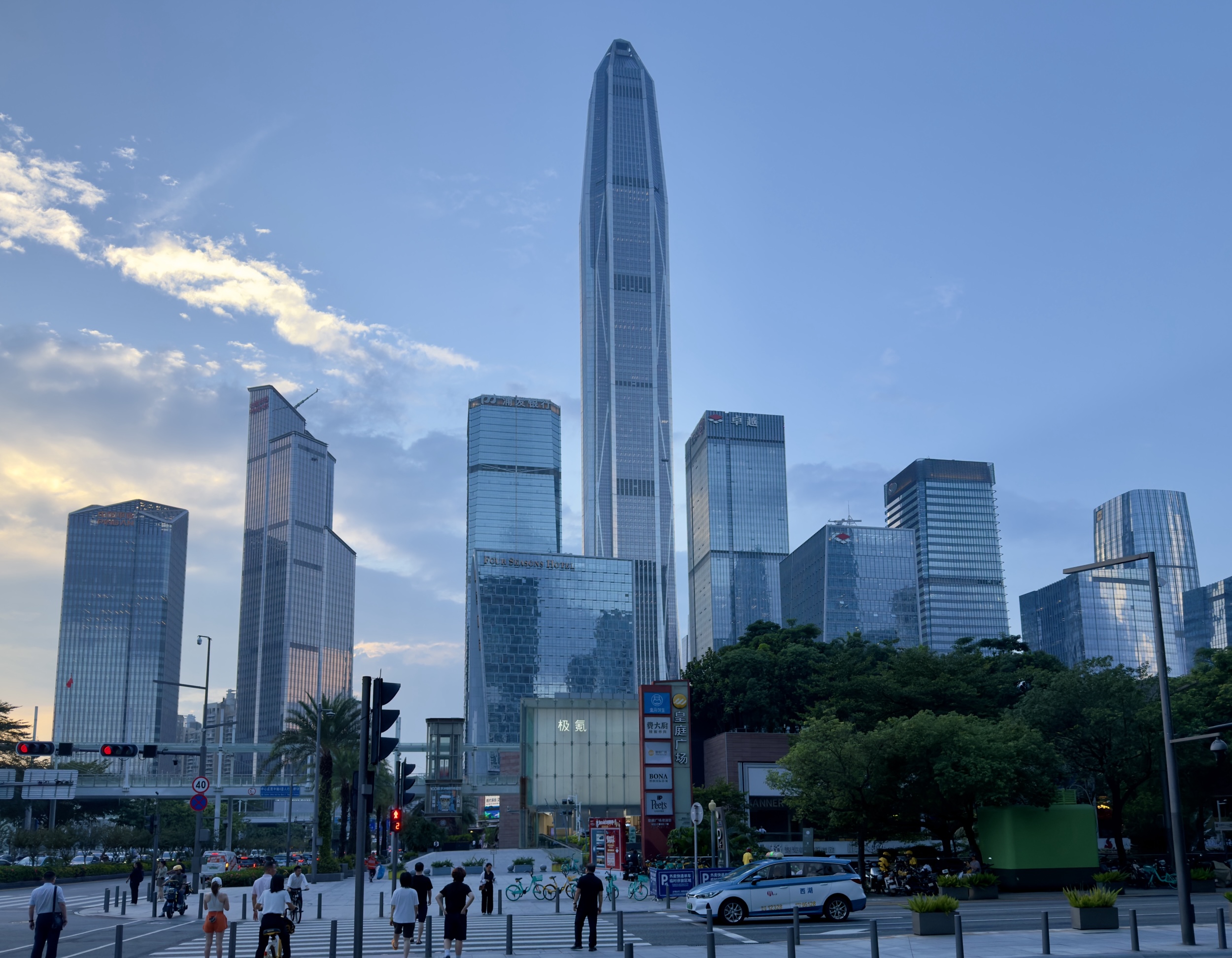
In the late afternoon I went to the Ping An Finance Center, 599 meters tall and the second-tallest building in China. It was designed to be about 60 meters taller, but the spire was dropped in 2015 over concerns that it would get in the way of aircraft. I took the elevator up to Free Sky, the observation deck on the 116th floor. At 562 meters it is the highest observation deck in any building in the world. I had guessed as much before I went, and for once my guess turned out to be right.
I stayed up there for an hour while the sun went down and the lights came on across the whole city, towers in every direction to the horizon.
When Shenzhen became a Special Economic Zone, I was twenty-five. Everything I was looking at was built in the time since. That is a strange thing to stand on top of.
Dinner in the basement, then the metro back to the hotel.
A first-class seat by accident. Six gadgets I did not need. A city that was not there when I passed by in the 80s, seen from 562 meters.
Shenzhen, the practical stuff
- How long is the train from Yangshuo to Shenzhen? — About 2 hours 40 minutes by high-speed train from Yangshuo station to Shenzhen North (11:25 to 14:04 on my day). Yangshuo station is about 45 minutes from town by DiDi.
- Is first class worth it on a Chinese high-speed train? — When second class is sold out, yes. Seats are 2+2 instead of 3+2, with water and a snack box, but otherwise it is much the same.
- Why is it hard to leave a Shenzhen metro station? — Many stations open straight into malls. Budget time to find a street exit, and ask the hotel which station is closest before you go.
- When do the Huaqiangbei electronics markets in Shenzhen open? — Around 10:00. Wander the floors; no list needed, and you may still leave with a bag.
- How high is the Ping An Finance Center observation deck in Shenzhen? — Free Sky 116 is 562 meters up. Go for the hour around sunset, when the city lights come on. The basement has restaurants for afterwards.
- Do you need cash in Shenzhen? — Rarely. Phone payment works everywhere, although the markets still take cash.
China 2026 — all posts
- 1 — Shanghaied
- 2 — Three days in Shanghai
- 3 — Xi’an, the beginning of the Silk Road
- 4 — Chengdu, panda town
- 5 — Chongqing, the world’s biggest city?
- 6 — Zhenyuan, the other Silk Road
- 7 — Xijiang, the village that is paid to look like itself
- 8 — Zhangjiajie, the mountain that was renamed after a film
- 9 — Yangshuo, the view on the twenty
- 10 — Shenzhen, from thirty thousand people
- 11 — Why China’s big cities are so quiet
- 12 — Hong Kong, nowhere to go but up
- 13 — Traveling through China’s holidays
- 14 — Taipei, four kilometers of gondola
- 15 — Alishan, the forest that left by train
- 16 — Tainan, where the gods answer yes or no
- 17 — Taiwan, a short history of a long question
- 18 — Why Uber in Taiwan sends you a taxi
- 19 — Hualien, a gorge you can only look at
- 20 — Jiufen, the gold you are allowed to touch
- 21 — Beware of Old Street
- 22 — Taipei, the crates that crossed the strait
- 23 — Shanghai again, through new glasses
- 24 — Train travel in China
- 25 — Paying for things in China, Hong Kong and Taiwan
- 26 — Getting online behind the Great Firewall
- 27 — China at 72
- 28 — Six weeks in China and Taiwan: the route, and what I would change
Before you go: Planning a trip to China · Essential apps for travelling in China