


Getting from Xijiang to Zhangjiajie took a shuttle bus, a bigger bus, a DiDi, two high-speed trains and a local bus. Every one of them ran on time, which in China I have stopped remarking on.
The DiDi from the west gate of Xijiang took about 45 minutes down to Kaili South, which left me an hour and a half early with a McDonald’s coffee and a hash brown. An hour on the train to Huaihua South, an hour’s wait, and lunch was dumplings from the station convenience store. My second attempt at dumplings in China, and the first one that worked. Then on to Zhangjiajie West, a bus up into the hills to Wulingyuan, and ten minutes on foot to the hotel.
Wulingyuan is the town at the main gate of the park. In the evening I walked over to Xibu, the old quarter, for dinner.
Pandora
The park gate opens at seven. Breakfast at the hotel started at seven too, so I skipped it, walked the twenty minutes to the gate and found hardly any line at all.
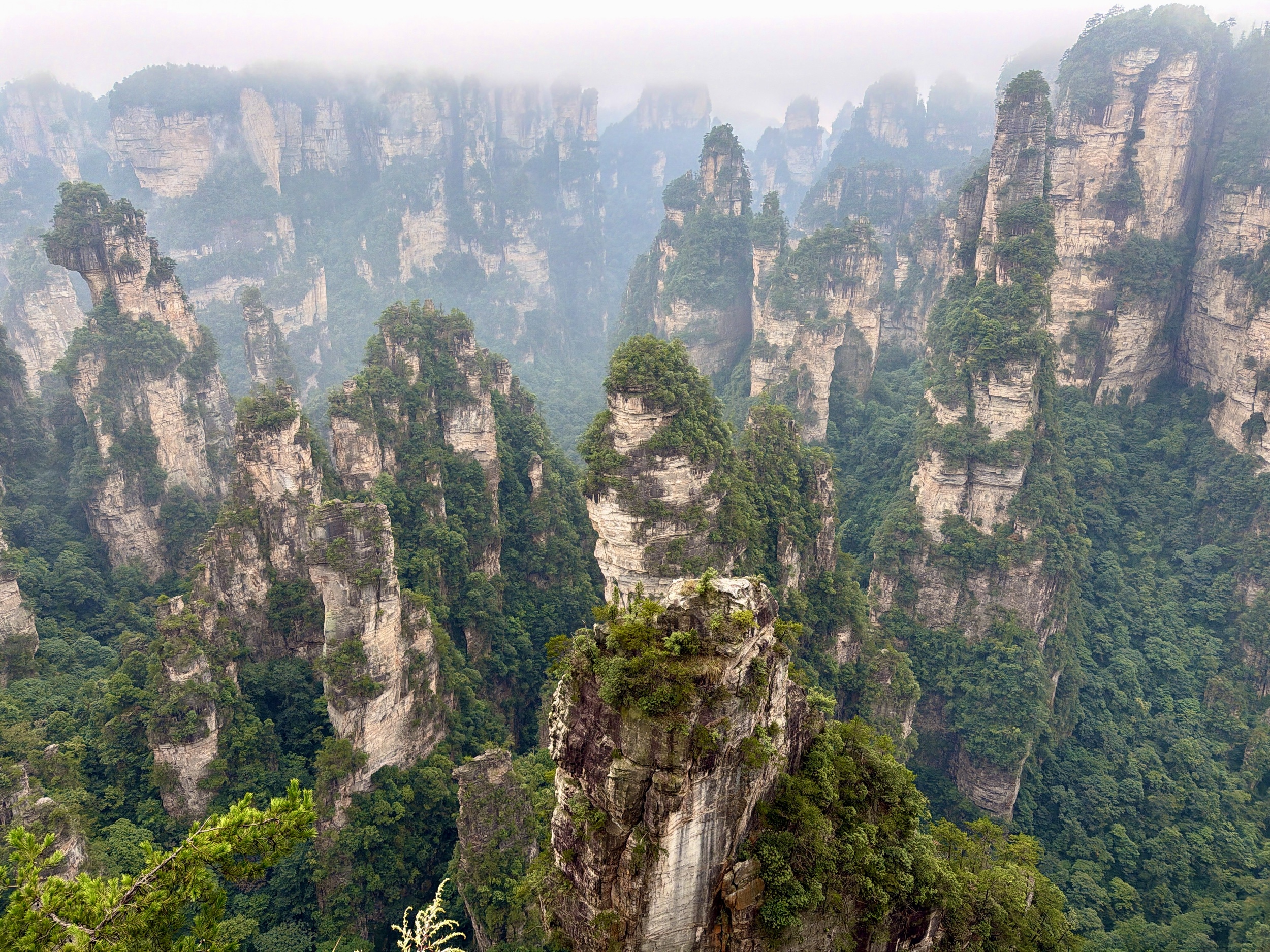
A park bus took me to the foot of the Bailong Elevator, three glass elevators fixed to the side of a cliff. It climbs 326 meters in about a minute and a half. You ride up facing the glass with the forest dropping away underneath, and at the top you step out into the middle of the landscape you came to see.
So did a great many other people. The crowds were already there when I arrived, and they thickened through the morning. I spent the rest of the day on the path along the top, from one viewpoint to the next.
What you are looking at is sandstone. Pillars of it, sheer-sided, packed close together, with pines growing out of the cracks and on the flat tops, and mist moving between them when you are lucky. It does not look like anywhere else, and that is precisely why it ended up in a film.
Avatar Hallelujah Mountain
One of the pillars used to be called the Southern Sky Column. Since January 2010 it has been called Avatar Hallelujah Mountain.
James Cameron’s Avatar had opened a month earlier. Its planet, Pandora, has floating mountains called the Hallelujah Mountains, and they looked a great deal like Zhangjiajie. The park did not wait. While the film was still in cinemas, its most photographed pillar had a new name and a new sign.
The claim is real, but it is shared. The film’s designers have said they drew on mountains from around the world, mainly three in China: Huangshan, Zhangjiajie and the karst around Guilin. Guilin, as it happened, was my next stop.
None of this was news to the park’s marketing department, and seventeen years later it is still working. I had titled my own diary entry for the day “Pandora” before I read any of it.
A beer at the top
By four o’clock I had walked myself to the top station of the Tianzi Mountain cable car, where there is a bar. I sat down with a beer and my phone and watched my bowling club at home, KK Strike, play a match. It was ten in the morning in Stockholm. I have followed bowling from some odd places, but never from the top of a mountain with a name borrowed from Hollywood.
Then the cable car down, with a long line for it, a bus back to the gate, the walk to the hotel, and sweet and sour pork across the street.
Looking up instead
The plan had Tianmen Mountain in it, a separate mountain on the other side of Zhangjiajie, with cliff walkways and one of the longest cable cars in the world. I woke up to rain, and it came and went for two days. Tianmen did not happen.
Around noon on the first wet day it eased, and I went back into the park to the Golden Whip Stream, which runs along the valley floor under the pillars. The day before I had looked down on them. Now I walked about three kilometers upstream looking up. It is beautiful, and it is also, honestly, a forest stream with remarkable rocks beside it. At the far end there was a cappuccino, and then I walked back.
The second wet day I stayed in and worked. Lunch in Xibu was a cashew chicken large enough to cancel dinner.
Zhangjiajie, the practical stuff
- How do you get to Zhangjiajie by train? — High-speed train from Kaili South to Huaihua South, about an hour, then on to Zhangjiajie West. A local bus runs from there up to Wulingyuan.
- Where should you stay for Zhangjiajie National Forest Park? — In Wulingyuan, the town at the park’s main gate. My hotel was a 20-minute walk from the gate.
- How do Zhangjiajie park tickets work? — They are real-name, one passport per ticket. A four-day pass bought in advance can include the Bailong Elevator and three cable cars.
- What time should you arrive at Zhangjiajie National Forest Park? — At the 07:00 opening, when there was no line. The viewpoints at the top were crowded by mid-morning.
- How high is the Bailong Elevator? — 326 meters, climbed in about a minute and a half in a glass-fronted car. It is the quickest way up by a long way.
- What can you do in Zhangjiajie when it rains? — Walk Golden Whip Stream, a flat path along the valley floor. I walked about 3 km each way.
- Is Tianmen Mountain part of the Zhangjiajie Avatar mountains park? — No. It is a separate mountain with its own ticket, near Zhangjiajie city. Allow a spare day for it, since rain can close it.
- Where do you eat in Wulingyuan? — On Xibu, the old street in Wulingyuan.
China 2026 — all posts
- 1 — Shanghaied
- 2 — Three days in Shanghai
- 3 — Xi’an, the beginning of the Silk Road
- 4 — Chengdu, panda town
- 5 — Chongqing, the world’s biggest city?
- 6 — Zhenyuan, the other Silk Road
- 7 — Xijiang, the village that is paid to look like itself
- 8 — Zhangjiajie, the mountain that was renamed after a film
- 9 — Yangshuo, the view on the twenty
- 10 — Shenzhen, from thirty thousand people
- 11 — Why China’s big cities are so quiet
- 12 — Hong Kong, nowhere to go but up
- 13 — Traveling through China’s holidays
- 14 — Taipei, four kilometers of gondola
- 15 — Alishan, the forest that left by train
- 16 — Tainan, where the gods answer yes or no
- 17 — Taiwan, a short history of a long question
- 18 — Why Uber in Taiwan sends you a taxi
- 19 — Hualien, a gorge you can only look at
- 20 — Jiufen, the gold you are allowed to touch
- 21 — Beware of Old Street
- 22 — Taipei, the crates that crossed the strait
- 23 — Shanghai again, through new glasses
- 24 — Train travel in China
- 25 — Paying for things in China, Hong Kong and Taiwan
- 26 — Getting online behind the Great Firewall
- 27 — China at 72
- 28 — Six weeks in China and Taiwan: the route, and what I would change
Before you go: Planning a trip to China · Essential apps for travelling in China