


I bought the ticket on a whim in April 2025. Norse Atlantic had a sale, the price was hard to argue with, and I clicked before thinking too hard about it. The gamble was not entirely trivial — Norse Atlantic is a low-cost long-haul carrier, and that segment has a poor survival record. Most airlines that have tried it have not lasted. But Norse is still flying, and in late November they took me to Bangkok as promised.
The actual planning did not start until late October, about four weeks before departure. I used ChatGPT to work through the route and timing, and Booking.com for most of the hotels. Between them, a 27-day itinerary came together faster than any trip I have planned before.
The flight from Stockholm left at 9.25 AM on a Norse Atlantic Dreamliner. Eleven hours, a window seat, and the kind of service where the cabin crew materialised once to offer water and then disappeared entirely. Norse Atlantic is not a carrier you would choose for the experience. But it gets you there, and the Dreamliner is comfortable enough for the price. By the time I landed in Bangkok at 4.30 in the morning, cleared immigration, found an ATM, and got to my hotel, I had been travelling the better part of a day. I set no alarm and slept until 10.30.
Bangkok
I stayed in Bang Rak, a few minutes from the Si Praya express ferry pier on the Chao Phraya, which turned out to be a better base than I could have planned. The river runs straight through the centre of the city and the ferries are fast, cheap, and cut through the traffic entirely. Bangkok traffic is not something to attempt voluntarily.
The first morning I wandered toward Chinatown, found a temple, had some coffee, and kept moving. The neighbourhood has the particular energy of a place that has been doing exactly what it does for a very long time and has no plans to change. That evening I went up to the Sky Bar on the 64th floor of the State Tower. The view over the city is everything the photographs suggest: Bangkok stretching in every direction, the river looping through it below, the haze of a city of ten million softening the edges. The cheapest item on the menu was 800 Baht. They did not serve beer. I had a single shot of Maker’s Mark and it cost forty dollars. The service charge alone was more than my dinner. I have no regrets.
The Grand Palace and the temples
Temple day came next. The express ferry to Tha Chang pier, then into the Grand Palace compound by 8.45 AM, fifteen minutes after opening and already crowded.
The palace is older than almost anything you can name in Bangkok, which is itself not an old city. Construction began in 1782, when King Rama I founded the Chakri dynasty and moved the capital from Thonburi to the east bank of the Chao Phraya. He needed a palace, a government, and a temple, and built all three within the same walled compound. For the next 150 years the Grand Palace served as both the country’s administrative and religious centre: the residence of the monarch, the seat of government, and the spiritual core of the kingdom. The king no longer lives there — the last to do so left in 1925 — but royal ceremonies still take place within the walls each year, which is why parts of it close with little notice. When I arrived most of the Grand Palace itself was shut for a royal ceremony. A useful reminder that the place is not a museum.
What I did get to see was Wat Phra Kaew, the Temple of the Emerald Buddha, in the northeast corner of the compound. It is regarded as the most sacred Buddhist temple in Thailand, housing a small jade Buddha statue installed here by Rama I in 1785, venerated ever since as the country’s palladium. The statue is smaller than you expect, but the setting around it is extraordinary: gilded walls, intricate coloured mosaic, guardian figures at every entrance. Three times a year, the king personally changes the Buddha’s gold seasonal garments in a ceremony that has continued unbroken since the dynasty began.
Wat Pho, a ten-minute walk south, is one of Bangkok’s oldest temples, pre-dating the city itself. King Rama I rebuilt it and made it his principal temple. Its main draw is the Reclining Buddha: 46 metres long and 15 metres high, depicting the Buddha passing into nirvana. The gilded statue nearly fills the building around it, and the soles of its feet are inlaid with mother-of-pearl in 108 sections. You walk alongside it and drop coins into a row of 108 bronze bowls. Wat Pho is also considered the birthplace of traditional Thai massage, and the practice continues on the temple grounds today.
Across the river by a short ferry, Wat Arun rises from the west bank: 70 metres of tower covered in Chinese porcelain fragments and coloured glass, with Hindu iconography woven through a Buddhist structure. Its name refers to Aruna, the Hindu god of dawn. When I was there the main occupation of the crowd was renting traditional costume for photographs. The temple was somewhat incidental to that project.
Khao San Road and MBK
On my last Bangkok morning I took a canal ferry — fast, efficient, a corrugated metal roof over a longboat threading through the city’s waterways — to the pier near Khao San Road.
Khao San Road is only about 400 metres long, which is not enough distance to dilute what it contains. Guesthouses, bars, travel agencies, pad thai stalls, street vendors selling scorpions on skewers and fake student ID cards with apparent equal conviction, clothing stalls, tattoo parlours, and at any hour of the day a crowd thick enough to slow you to a shuffle. It is relentlessly aimed at backpackers and makes no apology for it. I had a brownie and a cappuccino at a cafe on the way in, chicken and cashews for lunch at a table at the far end, and spent a pleasant hour in between going nowhere quickly. There is something straightforwardly enjoyable about a place that knows exactly what it is.
From there the canal ferry took me toward MBK Center: eight floors, around 2,500 stores, an entire floor devoted to phone accessories and repair. I had planned to buy an Under Armour shirt and I did, for 250 Baht. Then I picked up my bag from the hotel and flew to Chiang Mai on VietJet, my fifth flight with them and again without a problem.
Chiang Mai
Chiang Mai was founded in 1296 by King Mangrai as the capital of the Lan Na Kingdom, a northern Thai kingdom that remained independent from Bangkok for centuries. The old city is a near-perfect square, a square mile in area, enclosed by a moat and the remains of the original walls, with four main gates still standing. More than 300 Buddhist temples are scattered across the city, which sounds like an exaggeration until you spend a few days walking and lose count.
The scale is human, the streets quiet by Thai standards, and the temples close enough together that you move from one into the next without planning it. I stayed inside the old city walls, found a small bungalow with a double bed and not much else, and spent the first morning working outward from the hotel: the nearest temple 300 metres away, then the Gravity Cafe for a croissant and a cappuccino, then a temple with a noticeably tilting Buddha, then Wat Chedi Luang.
Wat Chedi Luang dates from the 15th century, built by King Saen Muang Ma to enshrine the ashes of his father. The chedi was once the tallest structure in the Lanna Kingdom at around 80 metres, before a 1545 earthquake brought most of it down. What remains is roughly half the original height, the brick worn and patched, large naga serpents flanking the stairways. Before the Emerald Buddha was moved to Bangkok it resided here for 84 years. The temple does not make much of this. It seems content with what it still is.
That afternoon I needed hiking shoes for Doi Inthanon the next morning. Two Apple Maps listings turned out not to exist. A third existed and was open but had exactly one pair in the right style and no other sizes. It took most of the afternoon and a Decathlon store found only by zooming into the map at a very specific scale before I came away with sandal-hybrids for 1,300 Baht. The Sunday Night Market that evening ran 1.5 kilometres from the main temple to the east gate, where I found on impulse a small North Face daypack for 400 Baht. By the end of the first full day in Chiang Mai I had better footwear and better luggage than when I arrived. Things tend to work out.
A rainy day later in the week brought Pad Thai for lunch at a restaurant that had fifty people queuing the night before, more temples in the afternoon, and a 30-minute foot massage for 200 Baht at a random place near the hotel. She found things in my feet I did not know were there. Add a beer and I was ready for the mountains.
Doi Inthanon
Doi Inthanon is the highest peak in Thailand at 2,565 metres, part of the Himalayan range, named after Chiang Mai’s last king, Inthawichayanon, whose remains are interred at the summit. The national park around it is one of the best birdwatching spots in Southeast Asia, though I was not there for the birds.
The minivan picked me up at 7.10 AM. By the time the driver had made nine more stops around the city we were twelve: Norwegians, Belgians, a Pole, a Slovak, a Korean student, and me. The Belgian worked in AI and we had a long conversation on the way, which felt like an unlikely topic for a cloud-covered trail at altitude but suited the journey.
The summit itself turned out to be a car park and a monument. The actual hike was a 5-kilometre nature loop through cloud forest, and that morning it was literally inside cloud: the views the guide had described were invisible, and the wooden stairs were wet throughout. The new sandal-hybrids had excellent grip. I did not fall once. The king and queen pagodas, built to mark the 60th birthdays of the Thai monarchs, were also clouded in. Lunch was rice and chicken. The afternoon stop at a small Burmese immigrant coffee village, whose families arrived from Yunnan about 150 years ago, was the real highlight: very good coffee, a quiet walk through the settlement, and the kind of place that gets few visitors and is better for it.
Pai and Mae Hong Son
The road to Pai has 762 curves. I took Dramamine as advised and found the ride considerably less harrowing than advertised. Three hours through forested mountains, arrived almost an hour early. Pai itself runs mainly on walking-street traffic, good coffee, and the occasional tour, but the hills around it are genuinely beautiful: rice paddies in the valley floor, bamboo bridges, karst ridges in the distance. The full-day tour covered hot springs, a pagoda under scaffolding (nice views of the town, though), a Chinese village, a waterfall, the bamboo bridge built so monks could reach their monastery without trampling the rice paddies, and finally Pai Canyon for the sunset. The sunset was behind cloud, but the canyon was worth coming for: narrow sandstone ridges with steep drops on both sides, very Utah, reminiscent of Angel’s Landing without the chains. I walked out a few sections without difficulty.
From Pai, a small bus threaded two and a half hours further through jungle mountains to Mae Hong Son, a small provincial capital close to the Myanmar border with almost no other foreign tourists during my visit. I rented a 125cc motorbike for three days at 300 Baht per day, which was one of the best decisions of the trip. Having your own transport in an area like this changes what is possible entirely: you stop when you want, take the photograph, and move on.
The first day: a bamboo bridge quieter and less visited than the one in Pai, then 25 kilometres on a bumpy dirt road to a Long Neck Karen village. The Karen are refugees from Myanmar, officially stateless in Thailand, and I was the only visitor. The women wore the traditional brass neck rings and went about their day without performing for me. I bought a couple of things and moved on.
The second day: 42 kilometres north to Ban Rak Thai, a village on a lake near the border, founded by Kuomintang soldiers and their families who retreated from Yunnan after 1949. Tea plantations above a lake, a Chinese character to the buildings, a quietness that does not quite feel Thai. Lunch was supposed to be fish and chips but arrived as chips only. I ate them and stayed for the view.
The third day I attempted a jungle hike and turned back at a stream crossing where the trail on the far bank had simply disappeared. The decision was correct, if not satisfying.
A bus returned me to Chiang Mai, then an Air Asia flight south to Surat Thani. Air Asia has been on every domestic leg of this trip, reliable and cheap, and this one was no different: departed on time, arrived on time, no drama.
Khao Sok National Park
Khao Sok sits in the hills of Surat Thani province, an hour by minivan from the airport. The park surrounds the Cheow Larn reservoir, created when the Ratchaprapha Dam was completed in 1982 and flooded a river valley. What the dam left behind was a landscape unlike anything else in Thailand: hundreds of limestone karst peaks rising directly from the water, some of them over 900 metres, draped in one of the oldest rainforests in the world. The scenery photographs well. It looks better in person.
My first night was in a cabin on stilts by the river at the edge of the park. When I arrived a troop of macaques were working the riverbank. I walked into the middle of the group. The mother made her view on this clear, and I stepped back. Then she left, and I spent a quiet few minutes near her infant, which was very small and entirely uninterested in me.
The overnight trip onto the reservoir was the reason I had come. The tour collected twelve of us in a Toyota Commuter van, stopped at the market for snacks, then drove to the pier. Two hours from pickup to the moment we actually got onto the longboat, which is typical of how these tours run. Once on the water the pace changed. The boat moved through the limestone towers in morning light, dropped us at a cluster of floating bamboo raft houses moored in a quiet inlet, and that was where we lived for the next twenty-four hours.
The raft houses are a particular kind of accommodation: basic but comfortable, rooms open to the breeze off the water, the lake going dark and very quiet once the other tour groups had eaten and gone to sleep. I shared a hut with Sebastian from Düsseldorf, 40 years old, first trip to Asia, genuinely curious about everything he was seeing. At dinner I talked for a long time with Yaron, an Israeli music producer who had been to more countries than I have and had opinions about all of them. We exchanged numbers.
The afternoon was a jungle hike up a waterfall, slippery and technical, shoes soaked, genuinely demanding for a 70-year-old at the end of a week of travel. I made it, which pleased me. The waterfall at the top was modest, but the guide’s commentary on the trees and plants along the way was among the most genuinely informative I have had on any tour.
The next morning I was up before dawn for the sunrise boat ride on the reservoir. The karst towers coming out of the mist, the light arriving slowly, the water flat and still. One of the better photographs of the trip.
Phuket
The minivan from Khao Sok dropped me at my Phuket hotel at 7.30 in the evening, the last of the passengers off, as usual. I had one full day.
Phuket has been a tourist destination since the 1980s, and in the decades since it has been developed with a thoroughness that leaves almost nothing untouched. The beaches are real and the sea is genuinely beautiful, but the infrastructure built around them — the hotels, the bars, the jet ski operators, the vendors, the noise — has reached a scale that makes it feel less like a place and more like a very large resort complex that happens to have sand at one end. Kata Beach, where I stayed, is routinely described as one of the quieter options on the island. It still had ten thousand people on it. This is not a complaint about Phuket exactly; it is what it chose to become. It is simply not what I was looking for on this trip.
I spent the day in Phuket Old Town instead, wandering among the Sino-Portuguese shophouses that date from the 19th-century tin mining boom. This part of the city has been preserved and is genuinely worth an afternoon: the architecture is distinctive, the streets are at a human scale, and the coffee is good. That evening I watched the sunset from a beach bar, had dinner, and called it done. The next morning I took the ferry to Phi Phi.
Phi Phi
The ferry took about two hours. Koh Phi Phi Don is a small island shaped roughly like a figure eight, its narrow waist occupied by the main town, beaches and the sea on both sides within a few minutes’ walk. It is as beautiful as its photographs and as crowded as its reputation.
The morning speedboat tour of Phi Phi Le the next day was the point: Maya Bay, where The Beach was filmed, now managed with strict visitor numbers after years of damage from overtourism. The coral is visibly recovering. The cliffs above the bay are extraordinary. We went on to swim in a sheltered bay, past the closed Viking Cave, and to two snorkeling stops. I had not snorkeled in years and was genuinely not sure whether the mechanics would come back. They did, and staying in the water at Shark Point longer than I had planned felt like a small but real thing.
That afternoon I was walking with fried chicken in a bucket when I needed a bathroom. I found one, rushed in without looking up, and walked directly into a low doorframe. A great deal of blood. I looked up the nearest clinic on Apple Maps and walked there, applying pressure the whole way.
The staff saw me immediately, cleaned the wound, and called a doctor to assess whether stitches were needed. He examined it carefully, concluded they were not, and prescribed antibiotics and anti-inflammatory medication. The nurses shaved a small area and applied a bandage that would stay on for the rest of the trip. They were unhurried, thorough, and genuinely kind, and I was grateful in a way that is hard to overstate when you are sitting in a small clinic on a Thai island with blood on your shirt, far from home. The whole thing cost about forty dollars. I went back to the hotel and stayed in for the evening.
Koh Lanta
The ferry from Phi Phi to Koh Lanta takes about an hour and a half. By the time I arrived I was ready to stop moving.
This was the deliberate part of the trip. After three weeks of minivans, overnight buses, motorbikes, boat transfers, and temples, I had booked six nights on Koh Lanta with no particular agenda, and I used all of them. My bungalow had air conditioning, a good bed, and a beach 100 metres away that stretches so far in both directions that you can walk for an hour without reaching the end. The island is about 30 kilometres long, relatively undeveloped compared to Phi Phi or Phuket, and the pace on the main strip reflected that.
I had also, by this point, probably given myself a mild concussion walking into that doorframe. I did not know this at the time, but the tiredness that pinned me in bed until 2 PM on my first full day was real, and the slower pace of the following days was less a choice than a requirement. I read, I wrote on the iPad from a cushioned platform at the Lighthouse Bar with the sea in front of me, I had good meals, I rented a motorbike one day and rode south to the national park at the tip of the island. I explored Lanta Old Town, a single street of shophouses built on stilts over the water, quiet in the morning heat, unhurried. I went back to the medical clinic twice to have the wound checked and rebandaged.
By the last couple of days I was genuinely rested. Not just the kind of rested that comes from one good night, but the kind that comes from slowing down long enough for the accumulated weight of the previous weeks to lift. Koh Lanta earned its place on this trip.
Railay and Tonsai
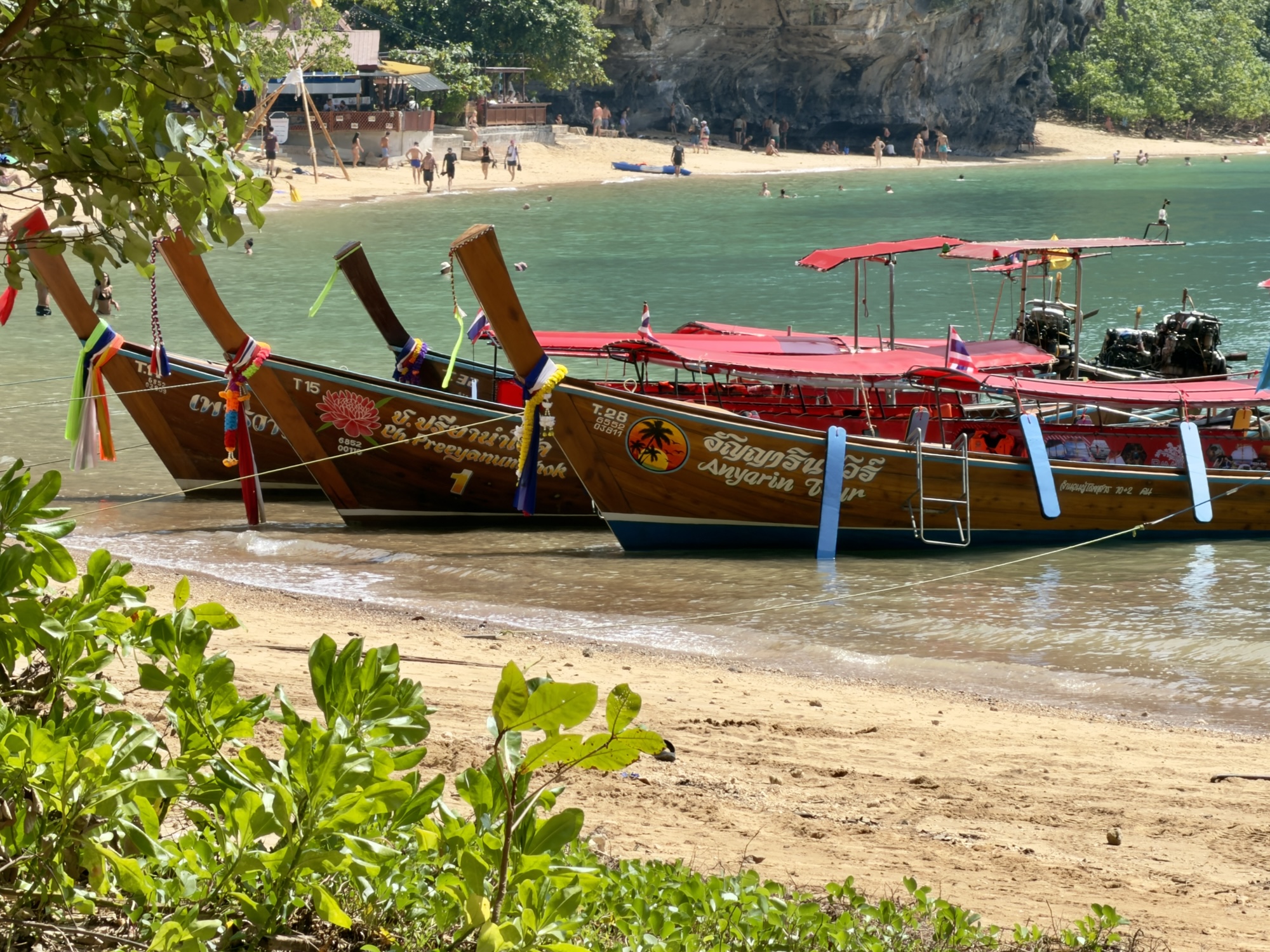
From Koh Lanta I took the ferry north to Railay, about an hour and forty-five minutes. Railay is only accessible by water, cut off from the mainland by limestone cliffs, and Tonsai is adjacent, even smaller, reached by wading from Railay at high tide through thigh-deep water or hiking over the cliffs at low tide. I waded. The water at Tonsai was deeper still and came up almost to my backpack. The bottom was rocks and broken coral. A Spanish woman I had just met took my hand and we got to shore.
The resort on the hill had no air conditioning, electricity only from 5 PM, a fan, and mosquitoes. The netting came out immediately. In compensation, the beach in the mornings, with the karst towers around it and climbers already working the walls by 8 AM, was something to see. Rock climbing draws people to Tonsai specifically, and the presence of climbers gives the beach an energy that Railay, more developed and more visited, does not have.
Getting back to Railay the following morning involved waiting an hour for other passengers to share a longboat, finding a different boat, then spending the afternoon in Railay before my transfer to Krabi airport. I found a Patagonia hat to replace the blood-stained one from Phi Phi. A minivan to the airport, a Bangkok Air flight to Bangkok, a pre-booked car to my hotel just before midnight.
One last day in Bangkok
I had booked a tour for the final day: the Mae Klong train market and the Damnoen Saduak floating market, ninety minutes each way from Bangkok in a full coach.
The train market is exactly what it sounds like: a regular market in a narrow alley with a live railway track running down the middle. The vendors set up right up against the rails, awnings extended over them, and when the train comes through three times a day they fold everything back, the train passes, and within seconds the stalls are open again. The crowd disperses after the train and that is it. It takes about five minutes. I had been on the bus for ninety minutes to see it and would do it again.
The floating market was harder to read: some genuine vendors, some clearly staged for the tourist longboats that come through in formation, and no reliable way to tell which was which from a boat. Interesting nonetheless.
That evening: MBK Center one last time, a Patagonia hoodie and two more shirts for 800 Baht, street food on the way back. At midnight a Bolt to the airport. A 12-hour overnight flight home. Stockholm just after 10 AM on a December morning, 7 degrees, cloud.
Twenty-seven days. Bangkok, Chiang Mai, Pai, Mae Hong Son, Khao Sok, Phuket, Phi Phi, Koh Lanta, Tonsai, Railay. Seven flights, all on time. One split head, two pairs of wet shoes, three days on a motorbike in the mountains, one very good sunrise on a reservoir, and more temples than I counted.
That is enough.